The Specialty Tea Procurement Audit: Calculating Labor Math, Hidden Export Compliance, and Supply Chain Integrity
Learn auditing tea lots objectively. Cut through broker marketing, navigate the true costs and protect your sourcing margins.

When Western sourcing managers or serious tea enthusiasts navigate the premium Chinese tea market, they are routinely met with an elaborate theatrical performance. Tins are wrapped in romantic marketing stories detailing "secret master processors" or "misty, spiritual peaks." Yet under basic scrutiny, these narratives rarely hold water. Origin fraud, unauthorized regional blending, and the substitution of handpicked spring crops with machine-cut summer harvests remain systemic risks.
To protect your business and your palate from overpaying for broker hype, you do not need mysticism. You need a logical framework. By understanding the raw agricultural labor economics of the spring harvest and the fixed costs of international food safety compliance, you can calculate the absolute cost floor of any lot.
I. The Dynamic Labor Equation: Seasonal Piece-Rates
The most reliable diagnostic tool for identifying supplier fraud is the physical mass-balance relationship between manual agricultural labor and finished dry yield.
1. The Biomass Shrinkage Constancy
During the thermal fixation (Shaqing 殺青) and dehydration stages of production, the raw moisture loss of the leaf is chemically constant. To secure a standardized yield of 500 grams of finished dry tea, an agricultural worker must harvest approximately 1,700 grams of fresh spring biomass.
2. The Weight-Based Wage Reality
In China’s tea-growing regions, harvesters are compensated strictly on a piece-rate system—paid by the weight of what they bring in. The faster and cleaner they pluck, the more they earn.
Because of this, the labor math is highly dynamic. During the highly prized Pre-Qingming early spring window, a skilled worker plucking a precise, lightweight "one bud, one leaf" standard can gather a realistic range of 300 to 450 grams of fresh leaves per day. Later in the season, as the leaves mature into a "one bud, two to three leaves" standard, the biomass becomes significantly heavier. Workers can pick faster and harvest more total weight, but the premium market reward per half-kilo drops accordingly.
3. The 60-Day Income Survival Gap
An industry baseline picker wage of 180 RMB (~$25 USD) per day serves as a normalized seasonal average, but it hides a critical agricultural reality. Tea plucking is not year-round factory work. The premium spring harvesting window is a volatile sprint lasting only 30 to 45 days out of the entire year. The wages earned during this brief window must frequently carry a farming family's annual expenses—including the off-season costs of weeding, natural fertilizing, manual trimming, and maintaining the farm's ecological balance for the remaining ten months.
When you apply these seasonal realities to early spring bud-selections, the raw field-labor cost baseline alone sits firmly at 765 RMB (~$105 USD) per half-kilo.
               [THE ANCIENT TREE MULTIPLIER]
    The standard equation applies strictly to terraced or bush estates.
    When sourcing from Old Wild Trees (Dashu) or Ancient Trees (Gushu),
    the labor economics shift drastically. Workers must carry heavy
    baskets and physically climb into high, wild branches. Because of
    the physical danger and slower movement, the labor time multiplies
    by at least 3x, pushing the cost baseline far higher.
II. The Sourcing Benchmarks: Lessons from the Domestic Market
This skepticism regarding pricing is not unique to the West. In the Chinese domestic market, consumers surrounded by tea heritage view pricing through a practical, transparent lens.
If a broker inside China claims to offer a "Pre-Qingming, One Bud One Leaf" selection for under 1,000 RMB (~$140 USD) per half-kilo, a local buyer will instantly suspect origin fraud or unauthorized blending.
However, if a lot is offered at 500 RMB per half-kilo, the domestic consumer does not assume it is "fake." They simply apply practical logic: they expect a standard "one bud, two to three leaves" harvest. Within the domestic market, open-mindedness prevails. Buyers recognize that slightly more mature leaves are highly viable, incredibly well-suited for daily mass drinking, and deliver an excellent, robust flavor profile. Not everyone pursues pure bud selections solely. Fraud only occurs when a broker takes that 500 RMB daily-drinking leaf, packs it in an exquisite box, and sells it to an unverified Western importer as a 2,000 RMB elite bud selection.
III. The Hidden Export Stack and the Micro-Lot Penalty
Moving premium tea across international borders requires absorbing a heavy stack of fixed regulatory overhead to meet international food safety expectations. These costs behave very differently depending on your shipment volume:
- Pesticide Residue Lab Testing: Authoritative screening panels (such as Eurofins or SGS multi-residue testing) are mandatory to pass strict European or American customs. A single comprehensive test carries a flat fee of $300 to $800+ USD per lot.
- Regulatory Documentation: Official Health Export Certificates, government phytosanitary inspections, and formal certificates of origin carry fixed administrative costs and strict timelines.
- Food-Grade Export Packaging: Protecting volatile leaves during long maritime or air transit requires high-barrier aluminum linings, nitrogen-flushed sealing, and reinforced outer structural cartons to prevent moisture absorption and aromatic decay.
The Volume Variable Math
Because compliance testing and export documentation are fixed fees, small-scale specialty buyers face a heavy financial penalty on low-volume shipments.
Total Cost Base = (Picking Labor X Biomass Shrinkage) + Processing Overhead + (Fixed Compliance Stack /Total Shipment Volume)
- The 20 Kilogram Micro-Lot: If you import a rare, small-batch cooperative lot of 20 kg, a flat $500 pesticide test adds a staggering $25.00 per kilogram penalty directly to your cost baseline.
- The 500 Kilogram Consolidated Lot: If you scale your shipment to 500 kg of the same tea, that identical $500 lab test adds a mere $1.00 per kilogram to the cost floor.
If a broker offers you a tiny, exclusive 15 kg micro-lot of pristine spring tea but cannot present a lot-specific independent lab report, they are skipping compliance filters entirely or blending unverified smallholder outputs under a single generic regional certificate.
IV. The Fallacy of Linear Value: Freshness Decelerators vs. Vintage Scarcity
A common psychological trap for Western buyers is assuming that tea pricing scales linearly with sensory output—the belief that a tea costing $200 per kilo must automatically taste "twice as good" as a tea costing $100 per kilo.
In a modern, market-driven supply chain, premium pricing is not dictated by production costs plus a predictable profit margin; it is driven entirely by the volatile forces of supply, demand, and time-sensitivity mechanics.
               [THE TIME-VALUE DIVERGENCE]

    GREEN TEA: Value is a ticking clock. High velocity, zero shelf-life.
    AGED PU'ER: Value is an appreciating asset. Low velocity, infinite shelf-life.
Take early spring green tea: its value is anchored to a strict premium on absolute freshness. If a pristine "one bud, one leaf" selection arrives at your door via air-freight by April 10th, the cup profile on April 11th is unparalleled—vibrant, highly volatile, and rich in delicate amino acids. However, six months later on October 11th, that exact same leaf has naturally oxidized and degraded, regardless of how tightly it was sealed. The premium price paid for green tea is a investment in logistics speed and immediate seasonal demand.
Conversely, authentic aged Pu'er operates on the exact opposite economic spectrum. Time does not destroy its value; it creates it. Through decades of slow, controlled microbial post-fermentation, the sharp, raw characteristics of the leaf transform into a deep, heavy complexity. Because older cakes are continuously consumed and disappear from the market, time creates radical historical and botanical scarcity. This is why a vintage Pu'er tea cake shifts away from standard agricultural pricing entirely, scaling into a luxury collectible asset that can command tens of thousands of dollars at auction.
V. Operational Field Diagnostics: Squeezing the Theater
Experienced suppliers know that the leaf itself is the ultimate audit log. Before a single drop of water touches the sample, you can spot processing deceptions and warehouse corner-cutting right on the inspection table.
1. Dry Leaf Deceptions: Spotting Blending and Re-Firing
Brokers operating under high volume pressure routinely try to mask stale inventory or extend high-margin lots. Look for these visual corruption signatures in the dry leaf:
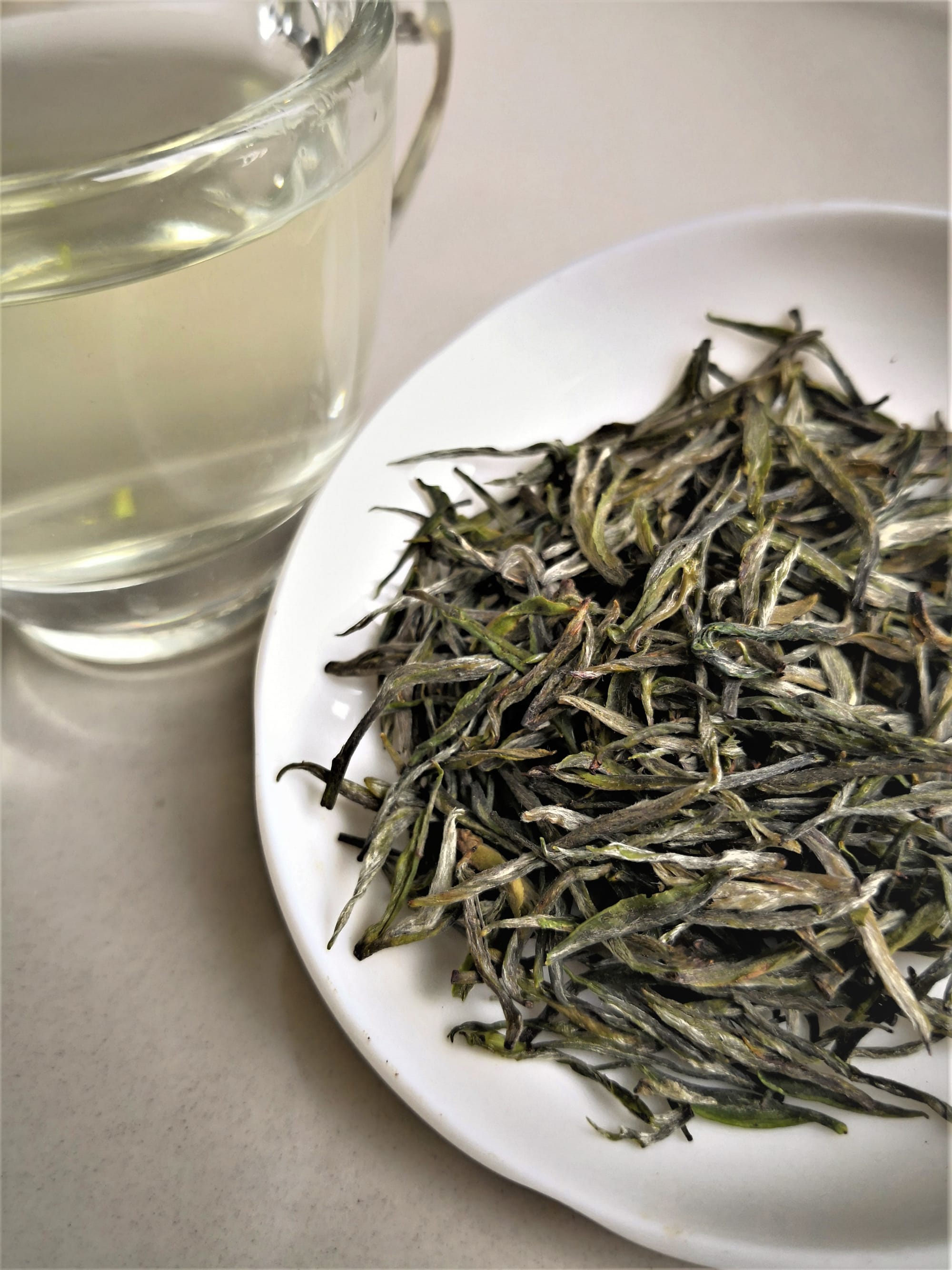
- Heterogeneous Batches: Examine the sample under direct, neutral light. Watch for subtle color banding or highly inconsistent leaf maturities—such as vibrant, pristine green buds sitting directly alongside tired, flatter, yellowish-brown leaves. This is a classic indicator of a broker blending fresh spring stock with reprocessed carryover inventory from a previous season.
- Re-Fired Fatigue: If the dry leaves appear uniformly darkened, dull, and completely lack the natural, healthy luster of true single-run processing, they have likely been re-fired. While a secondary factory roast can temporarily dry out stale leaves and mask old-stock staleness, it permanently damages the delicate, volatile aromatic compounds, leaving you with a brittle leaf and a flat, hollow cup.
2. Wet Leaf Metrics and Wet-Harvest Defects
Once you initiate the brew, shift your diagnostic focus to leaf morphology:
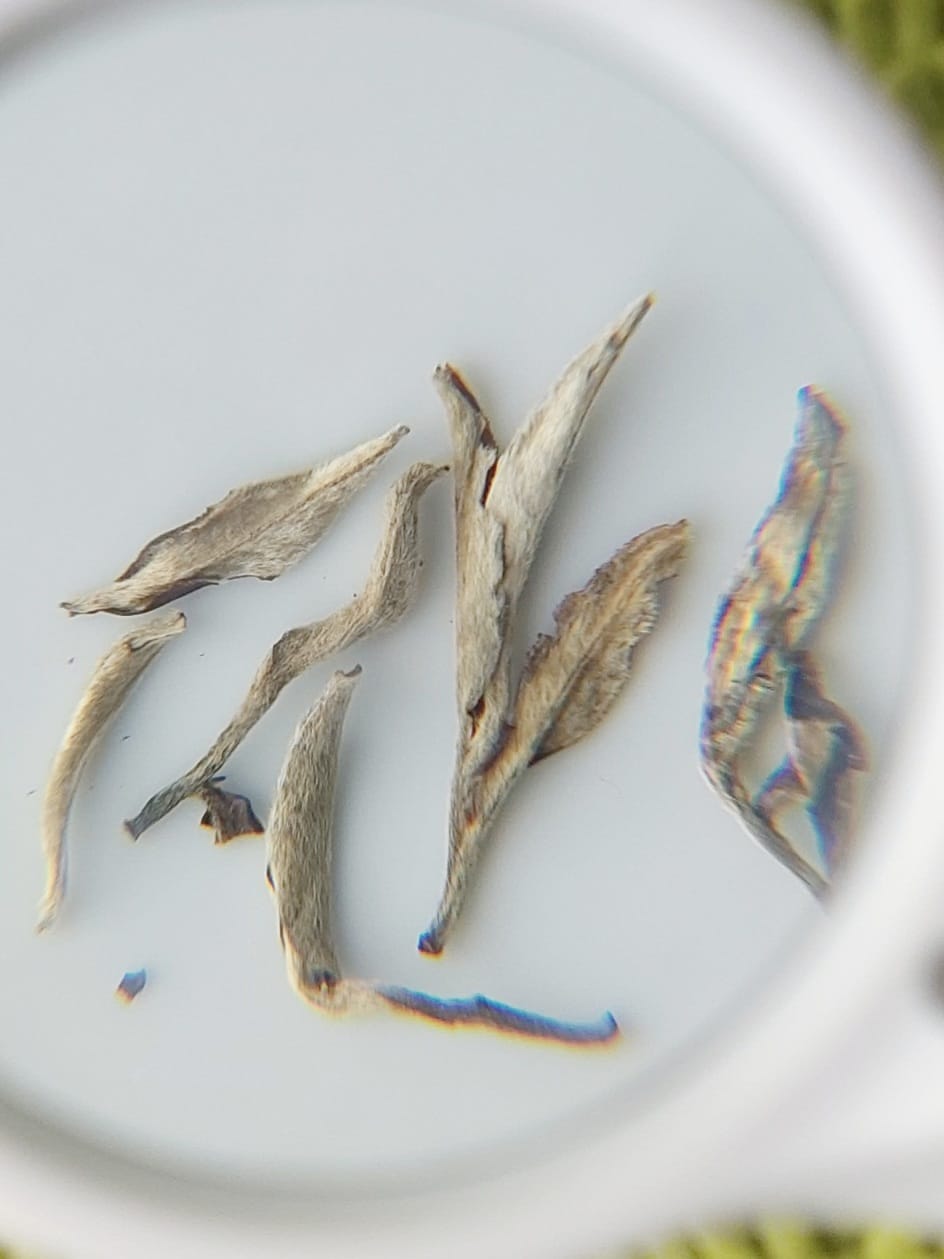
- The Cut Filter: Pour the exhausted wet leaves onto a flat, white surface. Authentic handpicked lots exhibit smooth, clean separation points where the picker’s fingers neatly detached the stem. If you find sharp, geometric, straight-edged perpendicular slashes cutting cleanly through stems or mid-leaves, it is machine-harvested. Machine shears cut indiscriminately, tearing the foliage, bruising cells, and leaving jagged fragments that cause rapid, bitter, and uncontrollable extractions.
- The Trichome Haze Rule: Genuinely high-quality, early-spring green and white selections are heavily covered in fine, microscopic downy hairs (trichomes). On your initial rinse, these trichomes should detach, creating a characteristic, soft suspended "haze" or emulsion in your teaware. If a supposed elite early-harvest selection pours completely crystal clear with zero suspended trichomes, walk away—they picked late, or mechanically polished the leaf to mask structural defects.
- The Weather Cross-Reference: If your sample exhibits a flat, dull, "stuffy" aroma with an aggressively hollow mid-palate and immediate, stinging astringency, the farm harvested during heavy seasonal rain. Rain-plucking traps moisture inside the cells, ruining the critical withering stage. (Note: For the full step-by-step methodology on how to isolate processing defects from genetic terroir, see our deep-dive in Paper 3: The Processing Subtraction Framework).
The Sourcing Verification Framework
Before wiring funds for a premium lot, cross-reference your supplier's invoice against this cold operational matrix:
[INVOICE AUDIT DECISION TREE]
          │
          ├── Wholesale Price < $105 USD per 500g?
          │     ├── YES ──> [REJECT] Probable Labor Exploitation or Origin Fraud
          │     └── NO  ──> Proceed to Logistics Filter
          │
          ├── Can vendor provide lot-specific Eurofins/SGS reports?
          │     ├── NO  ──> [REJECT] High Risk of Blended Bulk Material
          │     └── YES ──> Proceed to Physical Leaf Audit
          │
          ├── Color banding or re-fired dullness present on dry leaves?
          │     ├── YES ──> [REJECT] Blended Old Stock / Reprocessed Fraud
          │     └── NO  ──> Proceed to Stem Inspection
          │
          └── Geometric sheared cuts present on wet stems?
                ├── YES ──> [REJECT] Machine-Cut Substitution
                └── NO  ──> [APPROVE LOT]
Get the Broker Interrogation Script
Tired of navigating supplier theater alone? We have formalized our on-the-ground auditing protocol into a single, high-leverage tool. Subscribe to our newsletter below to download the free, print-ready "Tea Broker Auditing Script & Verification Scorecard" PDF—featuring the exact five technical questions you must ask a vendor to instantly determine if their lot matches the physical math of the leaf.
From Reading to Tasting: The Teativity Masterclass
To help you apply these structural diagnostics without needing to rely on a broker's marketing narrative, watch these two technical breakdowns from our Teativity framework:
Isolating visual data and structural indicators to audit a lot before it ever touches water.
Understanding leaf maturity dynamics and why a larger 1-bud-2-3-leaf harvest offers incredible drinking value.